Type:
ESA
“Haven” Class:
small
orbital colony Crew
/
passengers: 25/400 Power:
solar,
batteries Sensors:
40% Computers:
4
(+1 backup) Cargo:
800
m3 Weapons:
none
installed SP:
2 Damage
capacity:30 Cost:
500
million eb One
of
the more common small colonies, Haven has twin gravity wheels,
allowing
for pretty normal life. A number of these do serve as private
villas
for those rich enough. .
Type:
ESA
“Sentry” Defence Satellite Class:
combat
satellite Crew
/
passengers: fully automated Power:
solar,
batteries Sensors:
70% Computers:
4
(+2x2 backup) Cargo:
20
m3 (mainly ammo storage Weapons:
1
laser, 16 missiles SP:
4 Damage
capacity:
5 Cost:
50
million eb Your
standard issue combat platform, Sentry is a typical example of
it’s
class, and pretty cheap as well. Too bad ESA doesn’t sell these to
everybody willing... But once you get several Sentries, you may
form a
defensive perimeter around your asylum, and be pretty sure you
won’t be
disturbed.
Type:
Mitsubishi
– Koryidansu A-6 Class:
workshack Crew
/
passengers: 10 Power:
solar,
batteries Sensors:
30% Computers:
1 Cargo:
10
m3 (most cargo is stored externally) Weapons:
none SP:
1 Damage
capacity:
6 Cost:
5
million eb Your
basic, no-frills workshack. One of the early M&K desigins, it
can
be incorporated into their Modular Habitats, but it was designed
as a
stand-alone habitat. It’s tight, cheap, and uncomfortable, but
it’s one
ofthe most affordable orbital homes nowadays...
Type:
Utopia
SkyEye Class:
combat
/ surveillance satellite Crew
/
passengers: fully automated Power:
solar,
batteries Sensors:
80% Computers:
3
(+1 backup) Cargo:
none Weapons:
6
missiles, ECM SP:
0 Damage
capacity:
5 Cost:
15
million eb A
typical spy sat, SkyEye uses it’s advanced senors to pickup enemy
communications, and monitor space travel. In a pinch, it can
defend
itself, but in reality, this is more for show than of any real use
–
enough to keep occasional looters at bay, but far not enough to
keep an
enemy delata from taking it out.
Type:
USAF
Alamo-class Class:
battle
platform Crew
/
passengers: 8 Power:
nuclear Sensors:
80% Computers:
4
(+2x2 backup) Cargo:
20
m3 Weapons:
particle
gun, 2 lasers, 3 banks of 12 missiles each, a full set of
countermeasures SP:
6 Damage
capacity:
7 Cost:
90
million eb When
USAF goes into something, they want it as big, bad and ugly as
possible. The Alamo-class combat platform is no exception. Alamo
is one
of the most deadly small space installations.
Type:
Tupolev
Tsiolkovsky-class Class:
space
laboratory Crew
/
passengers: 12 Power:
solar,
batteries Sensors:
20% Computers:
3
(+1 backup) Cargo:
30
m3 Weapons:
none
standard, but suprisingly many of these labs are retrofitted with
countermeasures, lasers and missile banks SP:
0 Damage
capacity:
12 Cost:
30
million eb So
you
want to do some research, da? Tupolev will provide you with a
place for
it. They won’t ask you what kind of research you want to do, nor –
in
fact – who you really are. The living quarters are somewhat
spartan
(what have you expected from a Russian – made one?), and you’d
better
provide all the less universal equipment you’re going to use, but
apart
of that, Tsiolkovsky is a good idea.
Type:
USAF
Peacekeeper Class:
combat
satellite Crew
/
passengers: fully automated Power:
solar,
batteries Sensors:
80% Computers:
4
(+2 backup) Cargo:
10
m3 (mainly ammo storage Weapons:
2
lasers, 10 missiles SP:
4 Damage
capacity:
6 Cost:
70
million eb US
answer to the Sentry system, Peacekeepers are used as perimeter
defenses for many USAF installations in space.
Type:
MiG
Kosmos XII Class:
combat
satellite Crew
/
passengers: fully automated Power:
solar,
batteries Sensors:
55% Computers:
2
(+1 backup) Cargo:
20
m3 (mainly ammo storage Weapons:
1
laser, 2 kinetic weapons, 6 missiles, chaff, aerosol SP:
6 Damage
capacity:
8 Cost:
60
million eb Russian
combat
sat, this station is as Russian as a bottle of Stolichnya with a
Red Square postcard glued on. Tough, not very bright, but still
quite
effective. Kosmos – series battlesats are usually rigged in a very
nasty way – to compensate for limited targeting abilities, they
tend to
discharge as many weapons as possible in salvo after a salvo,
hoping
for a kill. While primitive, this tactic is quite effective as
well,
although numerous targets are known to stir confusion in Kosmos’
primitive computers.
Type:
NASA
Friendship-class Class:
large
orbital colony Crew
/
passengers: 30 000 Power:
dynamic
solar generators, batteries Sensors:
45% Computers:
4
(+10x2 backup) Cargo:
2000
m3 Weapons:
none
in standard, but almost any existing one has some weapnary
installed. SP:
4 Damage
capacity:
30 Cost:
5
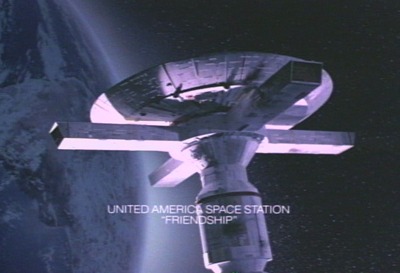
billion eb Friendship
is
bigger than O’Neill – type colonies, but also much more crowded.
Only the dish vsible at the end of the station is rotating, and it
provides living space for Friendship’s inhabitants. The rest of
the
station, including four docking arms just below the gravity dish,
are
imobile and subject to null-gravity. In fact, all workplaces that
don’t
require gravity to function are kept in the gravity free zone,
thus
they are pretty far from living quarters. The living quarters are
crowding in the dish. Whereas this method is practical, it’s far
from
comfortable.
Type:
Mitsubishi
– Koryidansu H-6 Modular Colony (aka “Anthill”) Class:
orbital
colony Crew
/
passengers: 15 / 50 (basic, depends on configuration) Power:
dynamic
solar generators, batteries Sensors:
40% Computers:
4
(+1 backup) Cargo:
100
m3 (basic, depends on configuration) Weapons:
none
standard (usually ECM pack and up to 3 lasers are installed) SP:
2 Damage
capacity:20 Cost:
150
million eb (basic configuration) H-6
has
an interesting feature: it’s gravity ring can be expanded by
linking
modules to it. These are standard M&K habitat modules, and
there is
a full choice of avalible ones – the most commn are living,
warehouse,
workshop, laboratory and greenhouse modules. Apart from that, the
Anthill offers a decent docking infrastructure..
Type:
Antonov
Mir 15 Class:
workshack Crew
/
passengers: 1 / 15 Power:
solar,
batteries Sensors:
25% Computers:
1 Cargo:
10
m3 Weapons:
none. SP:
1 Damage
capacity:
6 Cost:
2
million eb (price for a new one – no longer avalible) An
old
and outdated workshack desigin, the Mir (“World”) has been long
since
bested by M&K products. Nowadays, even Russians prefer
M&K.
It’s based on 20th century Russian concepts of a space laboratory
and
scientific station, just stripped from whatever wasn’t necessary
in
everyday life. However, a number of second-handed Mirs are
avalible as
cheap, no-frills living quarters.
Written
by Mike Van Atta, images from GI Joe, Armageddon, Bubblegum
Crisis,
Chris Moore, Macross, Gundam, Planetes, 2001, Lost in
Space,
Jovian
Chronicles, Silent moebius, and various other unkown anime
and artists